
Seaweed is the number one worry of American travelers before a trip to Playa del Carmen, in Quintana Roo, Mexico, and the question most travel sites answer with a shrug. Here is an honest status report: today's sargassum arrival index in the live bulletin right below, the official NOAA satellite map, the season month by month, and above all what to do when the beach is brown. Spoiler: it does not wreck a trip, as long as you know where to go.
Today's conditions, Playa del Carmen
Sunday, September 13Loading conditions…
NOAA satellite map of inundation risk
Produced daily by NOAA and the University of South Florida from satellite imagery. Red means high risk, orange medium, blue low.

Is there sargassum in Playa del Carmen right now?
The most reliable answer is in the live bulletin at the top of this page: it cross-checks today's wind with the season to produce an arrival index, and displays the NOAA satellite map, updated daily, showing the risk of seaweed washing ashore within about 30 miles (50 km) of the Quintana Roo coast.
Three sources cover the question at three different scales:
- The bulletin above for Playa itself, refreshed on every page load.
- NOAA CoastWatch for the whole Caribbean. Its Sargassum Inundation Risk product is generated every day from satellite imagery, and the University of South Florida's Optical Oceanography Lab publishes a monthly outlook of how much seaweed is drifting in the Atlantic. When USF reports a record spring offshore, expect a heavy summer on the beach.
- The Red de Monitoreo del Sargazo de Quintana Roo for beach-by-beach detail. Run by hydrobiologist Esteban Amaro, it posts a color-coded map of the entire coast on Facebook every morning: green (clean), yellow (light), orange (moderate), red (heavy). Hotels check it before they answer your email. You should too.
If you would rather see the coast with your own eyes, our page on the Playa del Carmen webcam lists the live cams that actually work in September 2026, and explains why a camera 22 miles (36 km) away tells you exactly what Playa looks like.
What sargassum is, and why it lands here
Sargassum is a brown floating seaweed that drifts across the Atlantic in rafts. Since 2011 a "Great Atlantic Sargassum Belt" has formed between Brazil and West Africa, fed by nutrients carried out to sea by the Amazon and by upwelling of deep, nutrient-rich water. Currents and trade winds push the rafts into the Caribbean, then onto the east coast of the Yucatán Peninsula, which faces the open sea with nothing to shield it.
At sea the seaweed is harmless: you can touch it, swim next to it, and it serves as a nursery for fish and sea turtles. The trouble starts on the sand. As it decomposes it releases hydrogen sulfide, the rotten-egg smell, and the water near the shore turns brown and warm. People with asthma or sensitive airways should not spend hours next to a large, decomposing mat. Everyone else just walks 200 yards up the beach.
Sargassum season in Playa del Carmen, month by month
The season is predictable in shape, not in size: low from November to February, peak from April to August, tapering in September and October.
| Period | Usual level | What it means for your trip |
|---|---|---|
| November to February | Low | Clean beaches almost everywhere, plus the dry season. Thanksgiving, Christmas and Presidents' Day trips are safe bets |
| March | Low to moderate | First rafts possible, still scattered. Spring break is usually fine, especially early March |
| April to June | High | The historic peak, with daily landings on exposed beaches |
| July to August | High | Still heavy, made worse by heat that speeds up decomposition. Summer family trips need a fallback plan |
| September to October | Moderate | Gradual decline, highly variable from one week to the next. Also the heart of hurricane season and the rainiest months |
Two caveats. First, every year is different: 2015, 2018 and 2022 were massive, other years nearly spared. The Atlantic belt is measured by satellite each month, so a record spring in the open ocean usually announces a heavy summer on the coast. Second, even at the peak, there are clean days: two days of west wind are enough to clear a beach.
Playa del Carmen beaches versus sargassum
Not all beaches are equal, and Playacar is the safest bet in season. From north to south:
- Punta Esmeralda and Coco Beach (north): very exposed, often among the first hit.
- The main beach, Mamitas and the beach club strip: exposed, but raked from 6 am by municipal crews and by the clubs themselves. Clean in the morning on days with moderate landings.
- Playacar (south): several hotels have installed floating barriers offshore and clean continuously. It is the most reliable stretch of Playa in season, and the best reason to book there from April to August.
Simple rule: in season, go to the beach in the morning, between 7 am and 10 am. In the afternoon, if the wind is onshore, the mats come back.
Where to swim when Playa is brown: 5 solutions
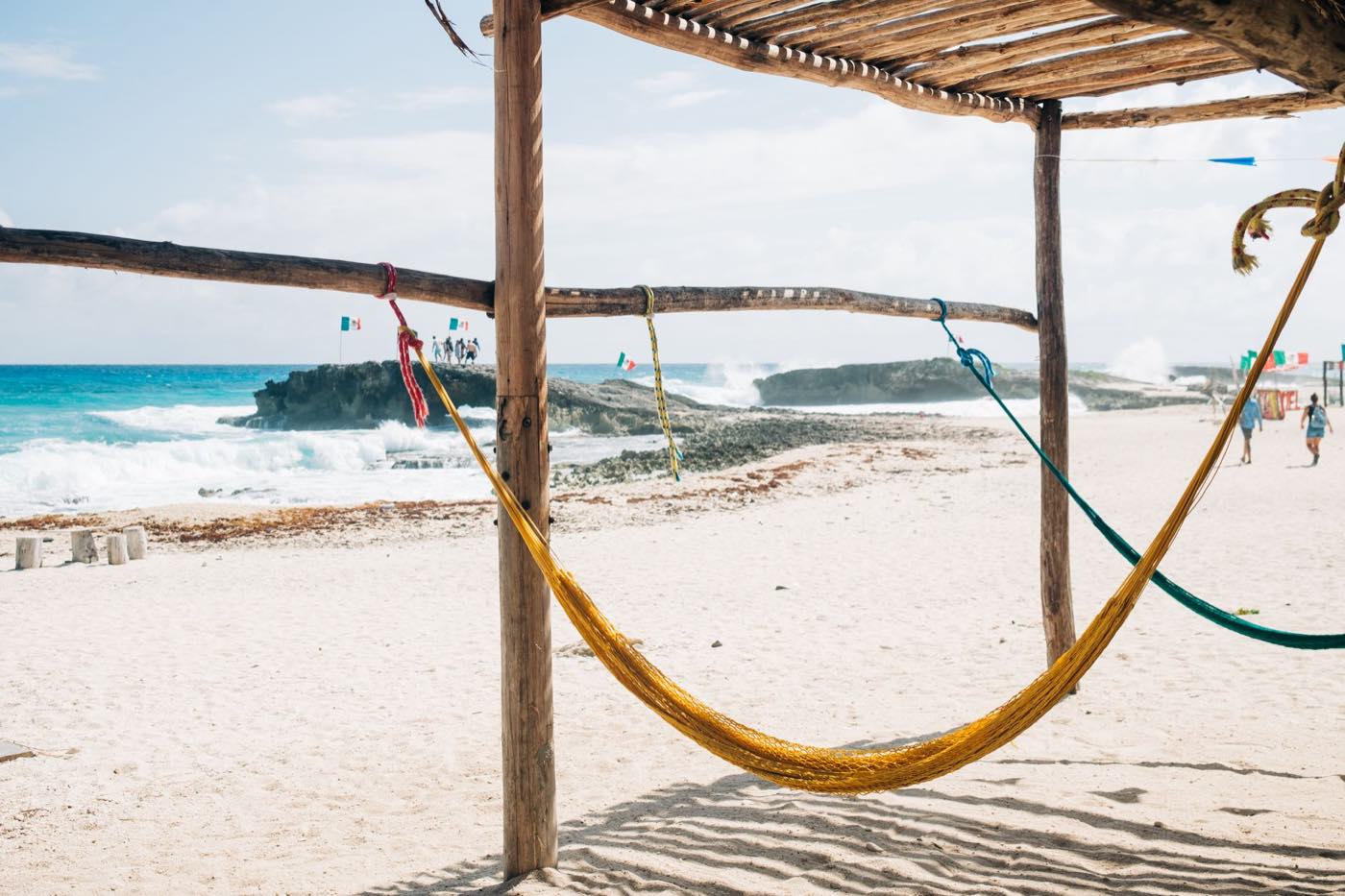
Cozumel's west coast is the best fallback day, and the other four are all within 3 hours of town.
- Cozumel, west coast. The island acts as a shield: Palancar, Chankanaab and the whole western shore stay clear. Ferry from the Playa pier, 35 to 45 minutes, hourly departures, 320 to 335 pesos ($19 to $20) each way, so roughly 550 pesos ($32) round trip. The snorkeling is better than anything in Playa anyway.
- Isla Mujeres, Playa Norte. Facing north, it escapes the rafts that come in from the east. From Playa, count on 1 hour of driving to Cancún, then a 20-minute ferry.
- The cenotes. Fresh, crystal-clear water at 75 to 77°F (24 to 25°C) all year, 15 to 40 minutes from Playa. Entry 100 to 300 pesos ($6 to $18). Never any sargassum, by definition.
- The water parks. Xel-Há and Xcaret have protected lagoons and underground rivers. Expensive, $110 to $160 per person for the day, but guaranteed seaweed-free.
- Bacalar. The freshwater "lagoon of seven colors", 3 hours south by car, never sees sargassum. Ideal for two nights at the end of the trip.
At a glance, for a family of four leaving from downtown Playa:
| Fallback | Travel time one way | Cost for 4 (transport + entry) | Sargassum |
|---|---|---|---|
| Cozumel west coast | 45 min ferry | About 2,200 pesos ($130) round trip, beach free | Never on the west side |
| Nearby cenote | 15 to 40 min by car or colectivo | 400 to 1,200 pesos ($24 to $70) entry, plus 100 to 200 pesos ($6 to $12) transport | Never |
| Isla Mujeres | 1 hr drive plus 20 min ferry | About 1,300 pesos ($75) in ferries, plus car or bus | Rare on Playa Norte |
| Xel-Há or Xcaret | 30 to 60 min by car | $440 to $640 with tickets | Never inside the park |
| Bacalar | 3 hr drive | Gas, or 2,800 to 3,600 pesos ($165 to $210) in bus tickets round trip, plus a night | Never |
Sargassum on the beach: the practical side
On a moderate day you can still swim, you just pick your spot and your hour. Walk 200 to 300 yards along the shore and the mats thin out where the beach curves or where a club has raked. Swim from a clear patch and stay out of the thick brown soup right at the waterline: it is warm, murky, and full of tiny critters that itch.
A few habits make a big difference:
- Water shoes for kids. Beached sargassum hides shells, small crabs and the occasional piece of plastic it has carried across the ocean.
- Rinse off after swimming through it. The seaweed itself is harmless, but the residue clings to skin and swimsuits and smells by evening.
- Ask the club or hotel what time they rake. Most start at 6 am and finish by 8 am; the beach is at its best right after.
- Check the wind before you commit. An east wind above 11 mph (18 km/h) means the afternoon will be worse than the morning. A west wind, even for a day, cleans the water fast.
- Keep the smell in perspective. Hydrogen sulfide is unpleasant but only reaches irritating levels next to a large mat that has been rotting in the sun for a day or two. Ten yards away it fades.
Does Cancún or Tulum have less sargassum than Playa?
No, the whole coast gets it, but the details favor Cancún's hotel zone north of Punta Cancún and hurt Tulum. Cancún's north-facing beaches (from Punta Cancún toward Isla Mujeres) sit at an angle to the east wind and catch fewer rafts. The east-facing stretch of the hotel zone gets the same as Playa. Tulum is the most exposed of the three: no barriers on most of the beach, and the hotels rake by hand. If sargassum is your main fear and you want to stay on the mainland, Playacar in Playa or the northern end of Cancún's hotel zone are the two smartest picks. The distance is small anyway: Cancún airport is 34 miles (55 km) north of Playa, Tulum 40 miles (65 km) south.
How to protect your trip before you book
- Look at the dates. For a beach-first trip, aim for December to March. It is also high season and the dry season, so it costs more, but you will not be disappointed.
- Choose a hotel with a sargassum barrier, or a pool you would happily spend a day at. The words "barrera antisargazo" or "sargassum barrier" show up in recent reviews when a hotel has one.
- Build a Cozumel or cenote day into your itinerary regardless of the season. You will want to go anyway.
- Book boat trips with free cancellation. Most sea excursions can be booked online with cancellation up to 24 hours before, which lets you shift a day around the wind.
- Do not count on a refund. No airline, hotel or standard travel insurance policy treats sargassum as a covered reason to cancel. The protection is in the choices above, not in the fine print.
What the authorities are doing
Since 2019 Quintana Roo has run a collection strategy: floating barriers off hotel zones, collector boats at sea, and cleanup brigades on public beaches. The Mexican Navy coordinates the offshore effort. The results are real but partial: barriers protect the stretches that have them, not the whole coast. Recycling projects (fertilizer, building blocks, biofuel) are moving forward without yet absorbing the volumes of a heavy year.
Frequently asked questions
What is the best time to avoid sargassum in Playa del Carmen?
From November to February the risk is low and the dry season makes the beaches perfect. March is still good. The peak runs from April to August, with a decline in September and October. If the beach is your priority, aim for December to March.
Is sargassum dangerous to your health?
Not to the touch and not at sea. Once beached and decomposing, it releases hydrogen sulfide (the rotten-egg smell) that can irritate the eyes and airways, especially for people with asthma. Just avoid sitting for hours next to a large decomposing mat.
Which beaches near Playa del Carmen never have sargassum?
The west coast of Cozumel (Palancar, Chankanaab), Playa Norte on Isla Mujeres, every cenote, and the freshwater lagoon of Bacalar. In Playa itself, Playacar is the best-protected zone thanks to the hotels' floating barriers.
Where can I find sargassum conditions beach by beach?
On the Facebook page of the Red de Monitoreo del Sargazo de Quintana Roo, which posts a color-coded map of the whole coast every morning, and on the daily NOAA CoastWatch satellite map shown on this page.
Do hotels refund you because of sargassum?
No. It is not a cancellation reason for hotels, airlines or standard travel insurance. That is why it pays to pick a hotel with a sargassum barrier or a great pool, and to book sea excursions with free cancellation. Before you book, check the beach live and today's index.